

Table of Contents
You see two bars. One says Fe 500. The other says Fe 500D. They look the same, but the second one costs more. Why? What does the D mean?
D means ductile. A ductile bar stretches more before it breaks. That small difference can decide how your house behaves in an earthquake.
In this guide, we explain the letter D in plain words. You will see how the grades compare, which one suits your home and how to check your bars. SBF Group has made steel in Bhiwadi, Rajasthan, since 1991, so we hear these questions often.
The D in Fe 500D and Fe 550D means ductile. A D bar is just as strong as the plain bar, but it can stretch more before it breaks. This rule comes from IS 1786, set by the Bureau of Indian Standards. Builders use D bars where the ground may shake, like in an earthquake.
Fe is the symbol for iron. The number shows how much force the bar can take before it bends for good. So Fe 500 means 500 MPa. The D means the bar can also stretch more on top of that strength.
Think of two twigs. A dry twig snaps with a loud crack. A green twig bends a lot before it breaks. A ductile TMT bar is the green twig.
Engineers measure this stretch as elongation. It is shown as a percentage. A higher number means the bar can stretch more before it fails.
The table shows the minimum values from the Bureau of Indian Standards (Amendment 3 to IS 1786:2008).
| Grade | Minimum yield strength | Minimum elongation |
|---|---|---|
| Fe 500 | 500 MPa | 12% |
| Fe 500D | 500 MPa | 16% |
| Fe 550 | 550 MPa | 10% |
| Fe 550D | 550 MPa | 14.5% |
Look at the last column. Fe 500D must stretch 16%, while plain Fe 500 needs only 12%. That is one-third more stretch. For Fe 550D the gap is bigger. It needs 14.5% against 10%, which is 45% more. Fe 500D also needs a higher minimum tensile strength, 565 MPa against 545 MPa, according to OfBusiness.
The yield strength does not change. D does not mean stronger. It means more flexible. You can see the full figures on our specification tables page.
India sits in an active earthquake region. The Ministry of Earth Sciences says about 59% of the country’s land can face moderate to severe earthquakes. Around 11% lies in Zone V and about 17% in Zone IV. Delhi falls in Zone IV.
During shaking, steel gets pulled and pushed again and again. A brittle bar can snap. A ductile bar bends and keeps holding the concrete. Engineers usually choose a D grade for buildings in seismic Zones III to V. Always follow your structural engineer’s drawings.
Fe 500D suits most homes and low-rise buildings. It gives high yield strength and good stretch. Fe 550D suits designs that need higher strength, such as taller buildings or heavy loads. Both are D grades. The right choice is the grade written in your structural drawing, not the cheapest bar on the shelf.
Do not swap grades to save money. Ask your engineer first. For a deeper comparison, read our guide on Fe 500D vs Fe 550D.
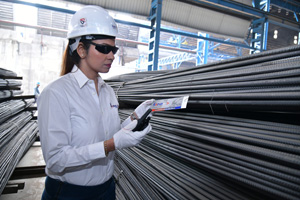
Do three simple checks before the bars go into your slab.
Our Quality Checkup Van helps here. A trained technician can visit your site and check the bars. This is part of the SBF Rapid doorstep after-sales service.
SBF Rapid makes Fe 500D and Fe 550D TMT bars in Bhiwadi, Rajasthan. The SBF Group plant has a combined capacity of 5 lakh metric tonnes a year. The bars are BIS certified, and our team checks quality before dispatch.
Building in Delhi NCR, Haryana or Rajasthan? See the SBF Rapid TMT bar price list, or call +91 70142-88818. You can also write to customercare@sbfrapid.com.
It means ductile. The bar has a minimum yield strength of 550 MPa and a minimum elongation of 14.5%.
The number is the minimum yield strength in MPa. Fe 550 bars have a minimum yield strength of 550 MPa, while Fe 500 bars have 500 MPa, so Fe 550 is about 10% stronger. Because of this, Fe 550 can carry the same load with a smaller bar diameter or fewer bars, which can reduce steel consumption in a design. Fe 500 is more widely used and usually costs less per kg.
Both have a minimum yield strength of 550 MPa under IS 1786. The “D” stands for ductility. Fe 550D bars bend and stretch more before breaking, with a higher minimum elongation (about 12% vs 10%) and a better tensile-to-yield ratio (at least 1.08 vs 1.06). They also have tighter limits on carbon, sulphur and phosphorus, which gives better weldability.
It suits shaking better because it bends before it breaks. Safety also depends on design and site work.